Air Resistance & Terminal Velocity
Air Resistance & Terminal Velocity
- Real falling objects push through air. (drag) acts against the motion and increases with speed.
- That one fact changes the whole fall: the acceleration is no longer constant, and the speed stops rising at a limit called .
The three stages of the fall
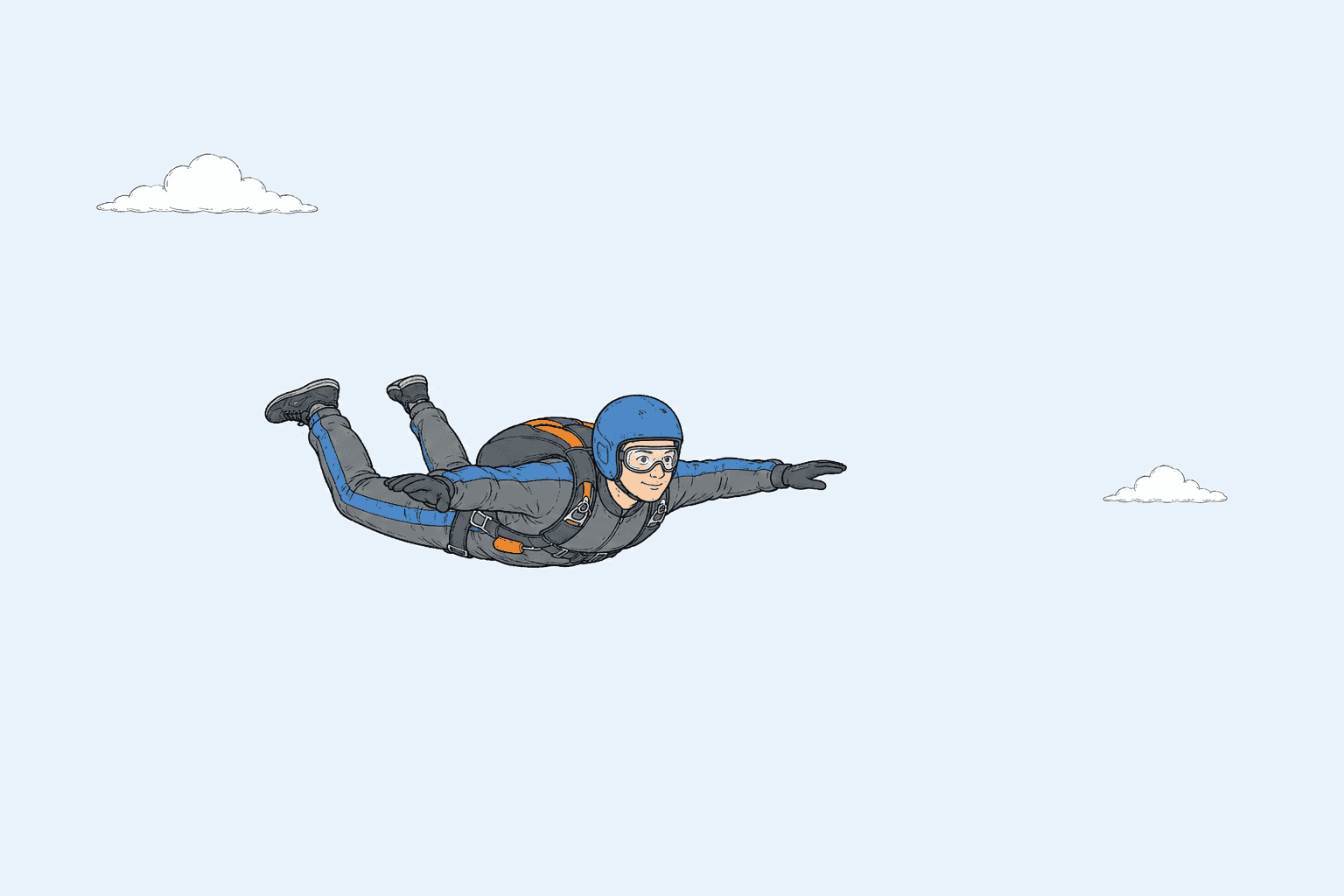
- At the start: the speed is low, so drag is small. The resultant force is nearly the whole weight, so the acceleration is nearly .
- As it speeds up: drag increases. The resultant force (weight − drag) gets smaller, so the acceleration decreases.
- At terminal velocity: drag has grown until it equals the weight. The resultant force is zero, the acceleration is zero, and the speed stays constant.
Terminal velocity is a force balance, not a speed limit built into gravity. The reasoning chain to write: speed up → more drag → smaller resultant force → smaller acceleration → zero.
Common mistake
“The acceleration becomes negative” is wrong. The acceleration decreases toward zero: the object never slows down on the way to terminal velocity, it only stops speeding up.
The exam's explain question
- The standard question gives a SUVAT prediction and asks why the real speed is lower. The answer is the reasoning chain, step by step.
Your turn— tap to reveal the worked answer (9702/21/O/N/23 Q2(b))
A tennis ball is released from rest at a height of 500 m. A passenger uses to predict an impact speed of about 100 m s⁻¹. Explain why the actual speed is much lower. (9702/21/O/N/23 Q2(b), 3 marks)
- Air resistance acts on the ball, and it increases with speed.
- So the resultant force on the ball is less than its weight.
- So the acceleration is less than g, and the final speed is less than 100 m s⁻¹.
The mark scheme does not claim the ball reaches terminal velocity: over 500 m it may not get there. Write “resultant force < weight, so acceleration < g” and stop.
- The same chain, reversed, explains why a falling object's v-t curve bends over: the gradient (the acceleration) shrinks as drag builds up, which is exactly the curve in the figure above.