Harmonics on Strings & in Pipes
Harmonics on Strings & in Pipes
- Tie a string down at both ends and pluck it. The ends cannot move, so the wave must have a still point (a node) at each end.
- Because of that one rule, the string can only make certain notes, not any note: the lowest one, then twice its frequency, then three times, and so on. That is where a guitar or violin note comes from.
A node at each fixed end
- A fixed end cannot move, so it must be a node. Both ends are fixed, so both ends are nodes.
- The simplest pattern that fits is one loop: a node at each end and one antinode in the middle. This is the (or first ) — the lowest note the string can make.
- One loop is long. That one loop fills the whole string of length . So , which gives .
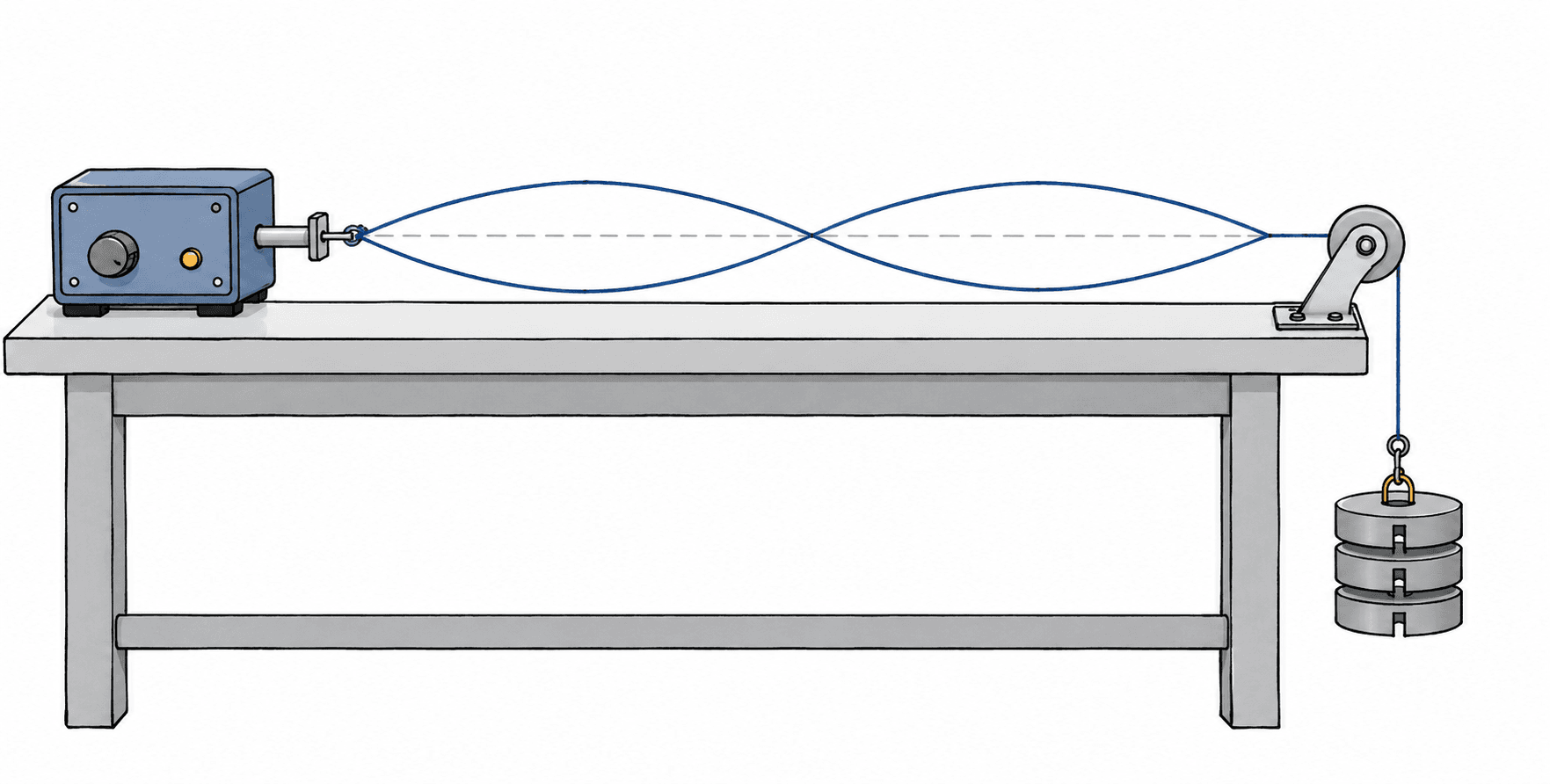
The harmonics
- Shake it faster and more loops fit on the string: 2, 3, 4… These are the harmonics.
- With loops the wavelength is , and the frequency is times the fundamental.
- A string gives every whole-number harmonic: 1, 2, 3, 4, and up.
Symbols
- = length of string (m)
- = harmonic number (whole number 1, 2, 3…) (no unit)
- = fundamental frequency (lowest, one loop) (Hz)
Worked example
Fundamental and third harmonic of a string
A string of length 0.60 m carries waves at speed 240 m/s. Find the fundamental frequency and the third harmonic.
- Fundamental: one loop, so m.
- Then Hz.
- Third harmonic: Hz.
n = 1·loops = 1·λ = 2l/n = 2l·f = n·f₀ = f₀
A string supports all whole-number harmonics (n = 1, 2, 3, …).
Node at each end. The fundamental fits half a wavelength (), and a string gives every whole-number harmonic .
Now a pipe: the ends set the rules
- A pipe of air works the same way, but its ends behave differently. Blow across a bottle and the air inside makes a note: a standing wave.
- At a end the wall is in the way, so the air cannot move. A closed end is a node.
- At an end the air is free to move the most. An open end is an antinode.
- Every pipe note comes from those two rules.
fundamental λ = 4l·harmonics allowed: odd only (1, 3, 5, …)
A pipe closed at one end
- Node at the closed end, antinode at the open end. The shortest fit is a quarter of a wavelength: , so .
- The next shapes that fit add a half-wave each time: , then , and so on. These give the frequencies , , .
- So a closed pipe gives only the odd harmonics: 1, 3, 5… The even ones never fit, so they are missing.
Symbols
- = length of air column (m)
- = odd whole number (1, 3, 5…) (no unit)
- = fundamental frequency (Hz)
Worked example
Fundamental of a closed pipe
A pipe closed at one end is 0.17 m long. The speed of sound is 340 m/s. Find the fundamental frequency.
- Fundamental: , so m.
- Then Hz.
A pipe open at both ends
- Both ends open, so an antinode at each end and a node in the middle. The shortest fit is half a wavelength: , so .
- An open pipe gives all the harmonics, like a string.
Your turn— tap to reveal the worked answer (9702/12/M/J/24 Q27)
A stationary sound wave in a pipe open at both ends has 3 nodes. How many antinodes are there?
Answer: an open pipe has an antinode at each end. Nodes and antinodes take turns, so 3 nodes sit between 4 antinodes (one at each end plus two inside). (9702/12/M/J/24 Q27)
A tiny correction: the end correction
The antinode at an open end does not sit exactly at the end. It sits a tiny distance beyond it, because the air just outside the pipe joins in. This small extra length is the end correction. You don't need it for AS. It is just why real pipes sound a little lower than predicts.